Short answer: wall lights are a stylish and functional addition to any interior. They supply layered lighting, highlight artwork and architectural features, create cozy or glamorous scenes, save floor space, and reduce energy use when specified with LED. This guide reworks those benefits into precise choices—mounting height, CRI, color temperature, IP rating, dimming method, and maintenance—so professionals can specify wall lights with confidence.
Key takeaways
- Wall sconces should be centered at 140–150 cm from the finished floor in dry living spaces; bedside reading lights need a lower, task-specific placement.
- Use IP44 for bathroom vanity sconces and IP65 where fixtures are near shower spray; IP20 is acceptable in dry rooms.
- Specify CRI≥90 and 2700–3000K for residential and hotel ambience; choose 3000–4000K for task-oriented areas.
- Wall lights free floor space, pair with dimmers for flexible scenes, and reduce energy use when fitted with LED sources.
- Builders should pre-wire sconce circuits and confirm mounting heights before drywall; property managers should standardize drivers and shades across units.
Why Wall Lights Matter in Interior Design
Wall lights play two roles at once: they deliver controllable lighting and carry visual weight in the room. They can be used in almost every room—from living room to bedroom, corridor to bathroom—and in styles that range from minimalist modern to classic brass. The result is a design tool that is as practical as it is decorative.
In a lighting plan, wall lights usually form the middle layer between ceiling downlights and floor/table lamps. They bring light to face height, where it can flatter people, wash a textured wall, or frame a piece of art without taking up floor space. For hotels, this layer is especially valuable because sconces convert a plain corridor or guestroom into a quiet, homelike space while reducing dependence on overhead lighting.
Wall Light Applications by Space
The same sconce family works across residential and hospitality projects if you vary mounting height, beam angle, and finish. The table below defines common applications and the minimum spec each space requires.
| Space | Typical wall light role | Suggested height | IP / CCT / CRI | B2B note |
|---|---|---|---|---|
| Living room | Accent on art, fireplace, or bookshelf; soft ambient layer | Center at 140–150 cm above floor | IP20, 2700–3000K, CRI≥90 | Add dimmer for evening scenes |
| Bedroom | Bedside reading, headboard accent, low-level night light | Shade bottom near seated eye level; reading lamp arm mounted 60–80 cm above mattress | IP20, 2700–3000K, CRI≥90 | Separate switch for reading side |
| Hallway / corridor | Wayfinding, wall washing, regular rhythm matching doors | 150–160 cm centered | IP20–IP44, 3000K, CRI≥80 | Hotels: use same spacing in every corridor for visual order |
| Bathroom vanity | Mirror lighting, skincare, hotel bathroom comfort | 150 cm to center, or paired vertical sconces at mirror edges | IP44, 3000K, CRI≥90 | Sealed driver outside humidity zone |
| Entryway | Welcome statement, table reflection, hat/coat area | 150 cm, usually in pairs | IP20, 2700–3000K | Pair symmetrical sconces for formal look |
| Reading nook | Task light on book or armchair | Adjustable arm; shade at seated eye level | IP20, 3000–4000K, CRI≥90 | UGR<19 to prevent page glare |

Highlighting Art and Architectural Features
One of the strongest uses of wall lights is drawing the eye to a specific object: a painting, a sculpture, a textured panel, a bookcase, or a fireplace. The goal is to light the feature without lighting the fixture itself.
- Artwork: place a picture light or adjustable sconce about one-third of the artwork height from the top, with a narrow beam (24–36°) to avoid washing the frame. Keep UGR<19 so the art reads clearly without glare.
- Bookcase: use linear LED strips on shelves or small wall washers above the unit, CRI≥90, 2700–3000K, so book spines keep their true color.
- Fireplace: two wall sconces flanking the mantel at 150 cm centered create symmetry and highlight the hearth without competing with the flame.
For hotel lobbies and property common areas, accent wall lights not only guide guests but also raise the perceived quality of finishes. Specify the same trim finish as cabinet hardware or door handles for a coordinated look.

Layered Ambience in Bedroom and Reading Nook
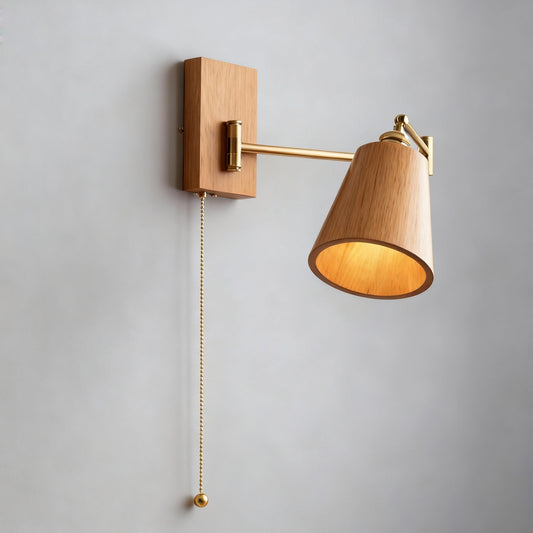
Wall lights are ideal for creating a cozy atmosphere when the main ceiling fixture would feel too strong. In a bedroom, install a bedside sconce with a dimmer: bright for reading, low for winding down. For a reading nook, a swing-arm wall lamp places light exactly at the page while leaving the side table free for a cup and a book.
For multispace residential and hotel projects, use 2700–3000K correlated color temperature and CRI≥90. This gives wood, textiles, and skin a natural warm tone. Add a dimmer or a two-step switch so the same sconce can produce a reading scene and a relaxation scene.

Statement Sconces for Entryway and Bathroom
Wall lights can add glamour to an interior by framing a moment of arrival.
- Entryway: a pair of elegant sconces on either side of the hall table frames the view and gives guests a warm welcome. Choose a finish that repeats a detail from the entry table, mirror frame, or door hardware.
- Bathroom: chic wall lights beside or above the mirror improve facial lighting. Wet areas around the shower or bathtub require IP65-rated fixtures; outside that zone, IP44 vanity sconces are the standard choice. Keep the driver in a ventilated space outside the humidity zone.
For hotel bathrooms, IP44 mirror sconces and IP65 shower recessed fixtures reduce maintenance and ensure guest safety. Specify glass shields rather than exposed bulbs for easier cleaning and lower bulb-replacement calls.

Practical Benefits: Small Spaces, Adjustability, and Energy
Wall lights solve space problems that floor lamps and table lamps cannot.
- Small rooms: a wall sconce uses zero floor area, making it the right choice in compact bedrooms, narrow hallways, powder rooms, and hotel landings.
- Adjustability: many wall light designs let you aim the head or arm to direct light exactly where it is needed. This makes one fixture usable for art, reading, and ambient scenes.
- Energy efficiency: LED wall lights run at far lower wattage than incandescent equivalents. Pair them with occupancy sensors in corridors or bathrooms to cut waste further.
- Maintenance: spec removable LED modules or accessible drivers to avoid whole-fixture replacement in hotels and rental portfolios.

Selection Guide: Style, Size, Placement, Light Source
When choosing wall lights for a project, finalize these four decisions in order: style, size, placement, and light source.
- Style: match the sconce to the interior language. A clean metal rod suits contemporary living rooms; a curved brass sconce works in formal dining or hotel lounge areas; a simple glass globe reads neutral across many decor styles.
- Size: sconce height should be about 10–25 cm less than the surrounding wall height in a small niche, and proportionally larger on a big stair wall or feature panel. Width should not exceed one-quarter of the wall where it is mounted.
- Placement: set 140–150 cm centered in living areas, 150–160 cm in corridors, and bedside at the height that keeps the shade below seated eye level to avoid glare.
- Light source: use LED for energy efficiency and long life. Dimmable LED drivers increase flexibility, and 2700–3000K CCT with CRI≥90 produces the warm, accurate color that suits living and hospitality spaces.
B2B Checklists
Lighting distributors
- Bundle wall lights by application: bedroom reading kits, bathroom vanity kits, corridor spacing packs, entryway pairs.
- Provide photometric data, IP rating, CCT options, CRI, driver type, and wattage on every cut-sheet.
- Stock spare drivers, glass shields, gaskets, and mounting brackets for hotel and property accounts.
Hotels and hospitality buyers
- Use IP44 bathroom vanity sconces and IP65 fixtures where exposed to shower spray; keep drivers outside the humidity zone.
- Standardize one sconce family for guestrooms and one for corridors to simplify maintenance and visual continuity.
- Specify 2700–3000K, CRI≥90, and dimmable LED to support nighttime scenes and housekeeping energy targets.
- Request replaceable LED modules and a spare-part list with asset-ID references.
Builders and developers
- Confirm final sconce placement and mounting heights before drywall so electrical rough-in is accurate.
- Issue a fixture schedule: model, cut-out, mounting height, CCT, CRI, beam angle, dimming, and room.
- Standardize one sconce family per project phase to reduce warranty mismatches and rework.
- Coordinate switch positions with bedside lamp arms and artwork plan to avoid blocking the light source.
Property management companies
- Choose wall lights with uniform SKUs and modular drivers so replacements are quick and predictable.
- Prefer anti-glare shades and enclosed glass for easy cleaning and fewer resident complaints.
- Use occupancy sensors in corridors and bathrooms to reduce energy cost without sacrificing safety.
- Keep a maintenance manual with cleaning, driver replacement interval, and spare part order codes.
FAQ
At what height should wall lights be installed?
Center sconces at 140–150 cm above the finished floor in living spaces, 150–160 cm in corridors, and at 60–80 cm above the mattress for bedside reading arms. The rule for task lighting: the shade bottom should stay below seated eye level.
What IP rating do wall lights need in bathrooms?
Use IP44 for vanity and general bathroom wall lights outside the shower zone. Where fixtures are exposed to shower spray or bathtub splash, choose IP65 rated enclosures and keep the driver in a ventilated space.
What color temperature works best for wall lights?
Specify 2700–3000K with CRI≥90 in residential, hospitality, and living areas for a warm, natural tone. Use 3000–4000K for reading nooks and task-oriented spaces where visual clarity matters.
Are wall lights more energy efficient than floor or table lamps?
Yes when specified with LED. LED wall lights use far lower wattage than traditional fixtures, take zero floor space, and, when paired with dimmers or sensors, produce less wasted light and improved energy performance.
Related products and resources
- Wall sconces and bedside reading lights
- Bathroom IP44 and IP65 wall lights
- Picture and art accent lights
Need a fixture schedule, product bundle, or project price? Contact our specification team for distributor programs, hotel packages, builder schedules, and property-management maintenance plans.